
Sushruta – Our Proud Heritage

The Department of Science & Technology (DST), under a programme called Science Heritage & Research Initiative (SHRI) has sanctioned a grant to a group of plastic surgeons, historians, Sancrit scholars and other affiliated domain expertd to dig into the history and gather some tangible evidence about the life and time of the great sage Sushruta. The fact that he was the ‘father of Plastic Surgery’ and his devised method of reconstructing a cut nose is still practiced today and the world calls it the ‘Indian Rhinoplasty’ is no longer debated. A statue of this great sage has found a proud place in the foyer of the Australian College of Surgeons in Melbourne and many medical institutions in India acknowledge his contribution by putting us his statues and paintings in their premises, a giant one in the garden of Amrita Institute of Medical Sciences in Cochin being the most eye catching.
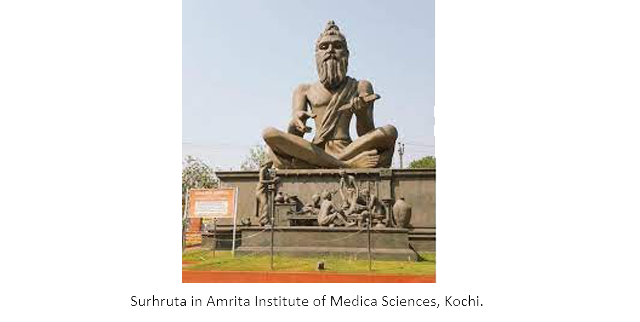
Sushruta is believed to be the son of a sage Vishwamitra and disciple of guru Divodas or Dhanvantari, the King of Kashi. History dates him to 600 BC-1000BC in the Vedic times, placing him on the time line, a millennium before the Greek physician Hippocrates and two millennia before another Greek, Galen and Roman,Celsius! It is today hard to believe that even as way back as 600BC a man performed complex surgical procedures including reconstruction of the nose by cheek flap, repair of cut earlobe, piercing of earlobe, repair of cut lip and skin grafting with medieval instruments that he himself manufactured. Not only does it say volumes about the quality of medicine being practiced then but also about the quality of metallurgy and engineering which must have coexisted in order to make the variety of instruments which Sushruta had designed after watching closely the beaks of birds and paws and jaws of animals!
Sushruta is said to have compiled a monumental thesis in surgery, the ‘Sushruta Samhita’. It is the oldest known surgical text and it describes in exquisite detail the examination, diagnosis, treatment and prognosis of numerous ailments, as well as procedures of plastic surgery, including reconstructive surgery and rhinoplasty. Written in Sanskrit in the form of Shlokas, verses and incantations, gilded by the flowery language and metaphors characteristic to Sushruta, the Samhita was not an easy text to decipher. It is regarded to be a part of Atharva Veda and the access to the Vedic knowledge was restricted to select few scholars of the ancient times. Such social factors may have contributed to the lack of dissemination of this ancient knowledge in India leading ultimately to our dependence on the Western world for our surgical know-how. The ancient Indian medical practitioners were divided into two classes: the Salya-cikitsakas (surgeons) and the Kaya-cikitsakas (physicians) but for a surgeon the knowledge of both the fields was essential.
While we will talk about the Sushruta Samhita in great details in the next issue, it is pertinent to mention that in this unique document Sushruta has described Anatomy, Physilogy, Surgery, Orthopaedics, Obstetrices & Gynaecology, Embryology, Opgthalmology and Urology in great details. Sushruta did not limit his teachings to procedures; he also described surgical instruments, catheters, sounds and irrigating syringes. He gave details of their manufacture (including the metal to be used and the measurements) and maintenance (cleaning by caustics and alkalis).
Treatment was not confined to surgery alone but there are descriptions on comprehensive perioperative care. Sushruta remarks: "the patient who has been fed, does not faint, and he who is rendered intoxicated, does not feel the pain of the operation." There is evidence of usage of wine and cannabis incense for inducing anaesthesia before surgery. So Sushruta can be safely considered to be ‘the father of Anaesthesiology’ as well!
He made his disciples practice their surgical skills on various experimental models, like incising on watermelon, gourd, clay pots and reeds, probing on worm eaten wood, just like in present day simulation skills workshops. So, practicing ob Surgical Simulators, which the wortld is rediscoverig today, had its initiation in the hands of Sushruta. Sushruta insisted on a sound knowledge of anatomy (Sharirasthana) and embryology in surgical practise and studies were conducted on decomposing cadavers and dead foetuses towards this aim.
Fourteen types of bandaging capable of covering almost all the regions of the body were described for the practice of the student on dummies. The use of surgical devices such as tourniquets and setting plasters also find a mention. Some important procedures, which preceded actual surgery, such as cauterisation by Ksaras (alkaline substances) or Agni (fire – heat) and application of leeches were being practiced extensively by him.
Apart from his surgical prowess, Sushruta was also a staunch proponent of good ethics, attitude and communication skills in surgical aspirants. According to him, "He is a good surgeon, who possesses courage and presence of mind, a hand free from perspiration, tremor-less grip of sharp and good instruments and who carries his operations to success and the advantage of his patient who has entrusted his life to the surgeon. The surgeon should respect this absolute surrender and treat his patient as his own son." Sushruta laid down the pre requisites for a qualifying surgeon as”A physician who has set out on this path should have witnessed operations. He must be licensed by the king. He should be clean and keep his nails and hair short. He should be cheerful, well-spoken and honest". He warns that improper intervention with surgical manoeuvre due either to ignorance of the progress of the disease process, greed for money or lack of judgment, lead only to complications. With such high standards set by the master surgeon and teacher, this era was regarded as the golden age of surgery in ancient India.
Sushruta had realized the importance of balance in knowledge and skill. In the Samhita he mentions, "a physician, well-versed in the principles of science of medicine but incompetent in his art because of want of practice, as well as the physician, experienced in his art but short on the knowledge of Ayurveda, is like a one-winged bird that is incapable of soaring high in the sky".
Sushruta remains our proud heritage and Sushruta Samhita is a living testament to his outstanding brilliance and colossal contribution to the science and art of healing. It is a pity that despite knowing a fair bit about this sage, teacher and exponent of surgical practice, there are still gaps in our trail of knowledge which only tangible evidence would be able to fill. Let us try to fill these missing gaps. I also invite you to watch a movie which the Association of Plastic Surgeons of India produced on Sushruta:
https://www.youtube.com/watch?v=rCFtR92JS-c
Reference:
Bhattacharya S. Sushrutha – our proud heritage. Indian J Plast Surg. 2009
Jul;42(2):223-5. PMID: 20368862; PMCID: PMC2845369.
Quiz time
What was the modern upper GI endoscope known during the time of Sushruta ?
Ans Nadiyanta
