
History of Surgery Part 5 – Surgery Instruments
Indian surgery remained ahead of European until the 18th century, when the surgeons of the East India Company were not ashamed to learn the art of rhinoplasty from the Indians’.- A.L.BASHAM (The wonder that was India, 1967)
Susruta was probably the first surgeon in the world to classify and describe, in detail, surgical instruments, their methods of manufacture, quality control, maintenance, and their specific uses in the diagnosis and treatment of diseases. He was also the first surgeon to describe endoscopes such as rectal, aural, nasal, and vaginal specula. First evidence of brain surgery in Bronze Age Harappa is reported by A. R. Sankhyan and G.R Shug in a scientific correspondence to Current Science. The communication states that it is the first report of its kind to unequivocally present a case of ancient brain surgical practice, known as trepanation, observed 4300 years ago in a Bronze Age Harappan skull. A decade ago, a Neolithic skull from Burzahoma in the Kashmir Valley was reported to have multiple trepanations, the first case from the Indian subcontinent. Trepanation, also called trephination or trephining, has been the oldest craniotomic surgical procedure practiced by mankind since the Stone Age, involving drilling or cutting through the skull vault of a living or recently deceased person.
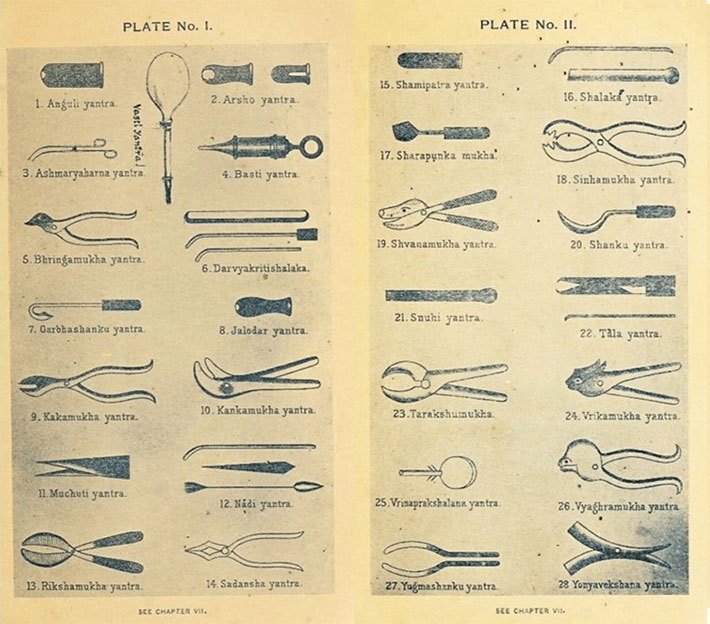
Blunt Instruments invented by Sushruta.
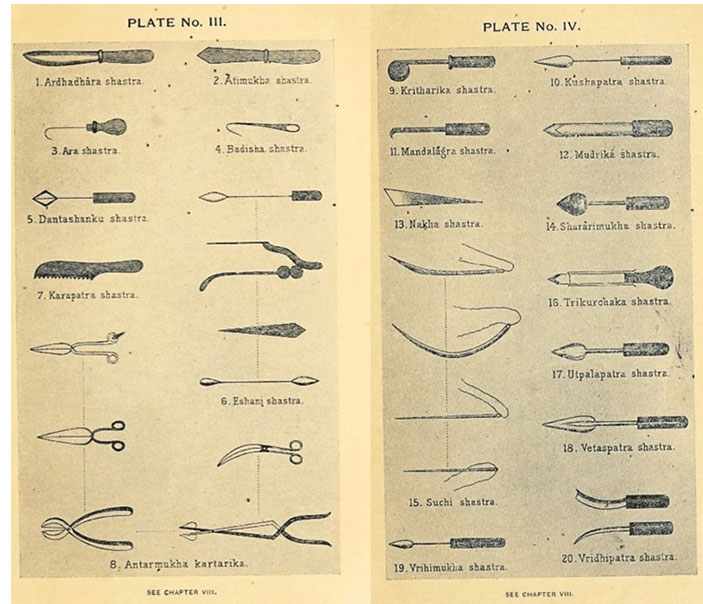
Sharp Instruments invented by Sushruta
Aggalayya’s Stone Inscription is a stone inscription in Telugu-Kannada Script is incised on three sides of a stone pillar set up in the village named Saidapur village, Yadgirigutta mandal (Bhuvanagiri Taluk), Nalgonda District of Andhra Pradesh. This inscription, which portrays the practice of surgery by select vaidyas in the medieval period, it evidenced by the subjoined inscription, which alludes the greatness of a surgeon named Aggalayya who flourished under the patronage of the Chalukya King Jayasimha II (A.D. 1015-1042) The mention of Aggalayya in an inscription, as a surgeon-physician in this context, shows that the practice of surgery was not completely given up by medieval period. It provides a glimpse of how surgeons and physicians held a high status during the reign of the Chalukya King Jayasimha. Aggalayya taught surgery to students from across India and served under four dynasties, earning the title 'Samanta Raja.'
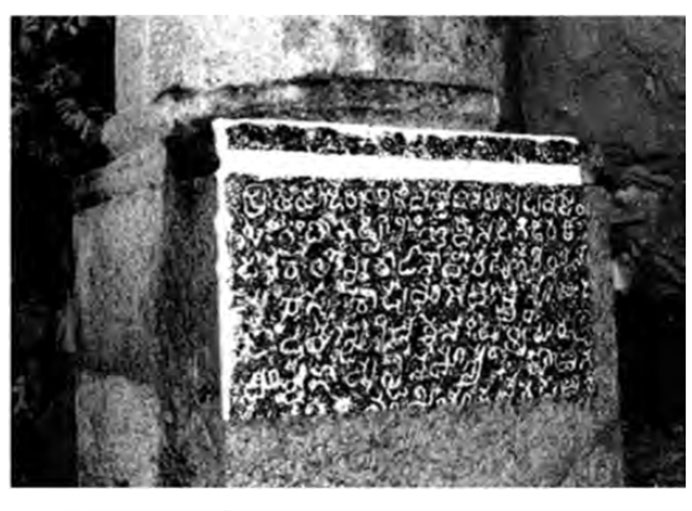
Figure 1 – Aggalayya’s Stone Inscription (1034 AD to 1074 AD )
While specific, individualized tools used by Aggalayya are not listed in the provided text, his era practiced Sastra-vaidya (surgery) based on the principles of Sushruta Samhita. Archaeological findings from similar periods in South India, specifically the Taxila Museum, provide examples of the types of instruments used at that time:
- Maṇḍalāgra: A disc-shaped blade instrument.
- Eśaṇī: Surgical probes.
- Sūcī: Needles with eyes for suturing.
- Saṁdaṁśayantra: Gripping instruments or forceps.
- Tālayantra: Spatula-type instruments with handles.
These instruments, including those for cutting, probing, and suturing, were used for various procedures, including vascular, rectal, and ophthalmic surgeries.
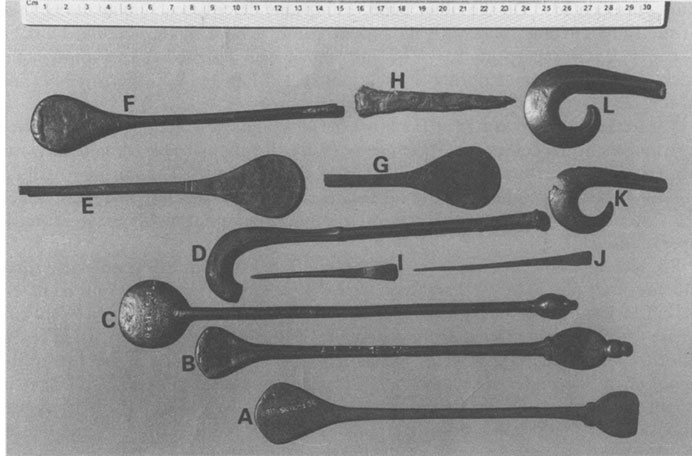
Figure 2- Surgical instruments in the Taxila Museum.
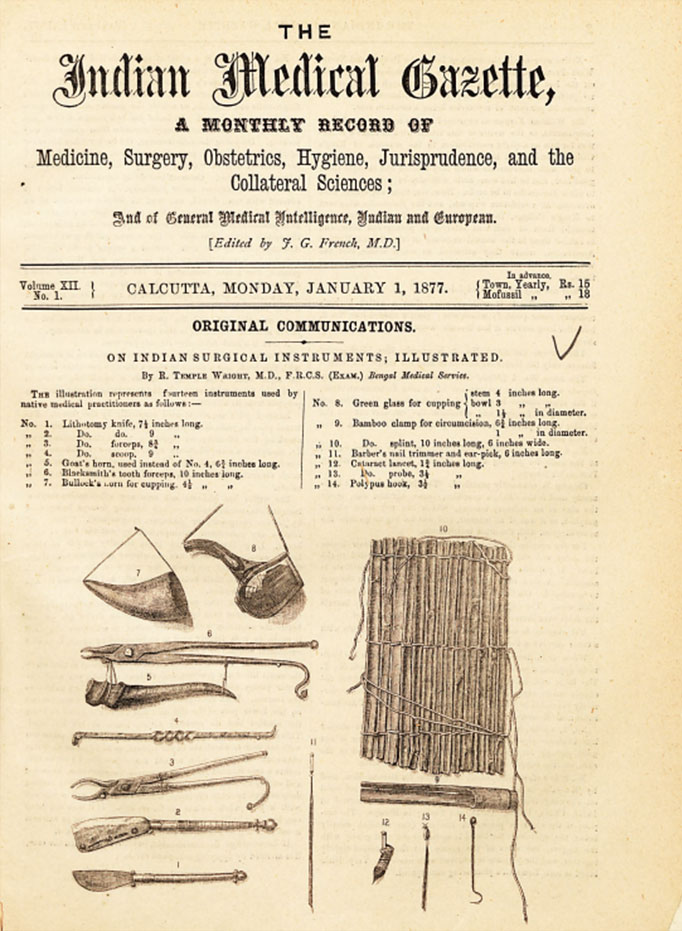
Indian Surgical Instruments (published in the Indian Medical Gazette in 1877 )
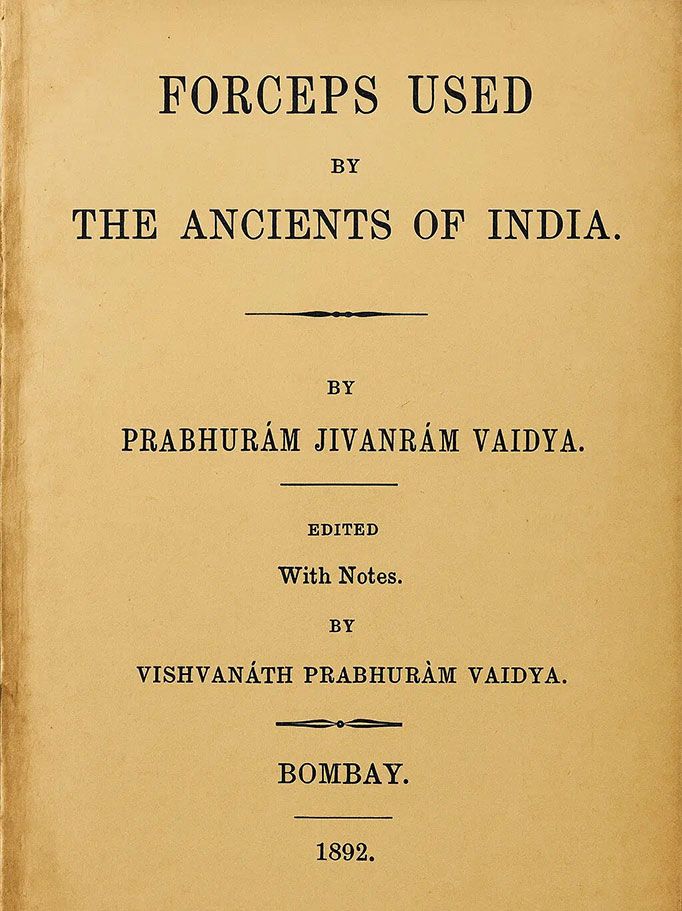
Among the pioneers who defended the scientific heritage of Ayurveda during the colonial era, Vaidyaraj Prabhuram Jivanram (1832–1902) stands as a monumental figure. A scholar of Vedanta, practicing Ayurvedic Vaidya, and realized yogi, he worked to rescue Indian medical knowledge from distortion at a time when European narratives often dismissed India’s surgical achievements.
One of his most remarkable contributions is the rare monograph “Forceps Used by the Ancients of India” (Bombay, 1892), edited with notes by his erudite son Vishwanath Prabhuram Vaidya. Printed in English, Sanskrit, and Gujarati, it is among the earliest scholarly attempts to document, analyze, and defend India’s ancient obstetric and surgical instruments as described in the Sushruta Samhita and related traditions. Today, copies survive only in a handful of repositories, including holdings in London—making it a treasure of Ayurvedic and world medical history. In this extraordinary monograph, Vaidya Prabhuram challenges the assumption that obstetric instruments were purely European inventions of the early modern period. He compares Sushruta’s Sandamsa (extractive tongs) and Anigraha, along with related techniques of rotation, traction, and controlled extraction, with their European counterparts—arguing that classical Indian obstetrics documented sophisticated tools and methods long before they were widely recognized in Europe.
He writes with clarity and conviction:
“The application of forceps in case of difficult labor, the different turning, flexing, and gliding movements, and other obstetric operations… were first systematically described by Sushruta long before fillets and forceps were dreamt of in Europe, and thousands of years before Christ.”
— Prabhuram Jivanram Vaidya, Forceps Used by the Ancients of India (1892)
The medical students in ancient India were trained to perform real surgery by observing mock surgeries on gourds, watermelons, and cucumbers. These resident students were from the Sushruta school (6th century BCE) and were known as Saushrutas. The students were trained in surgery for a minimum of 6 years, during which they were taught the principles of the “Susruta Samhita.”
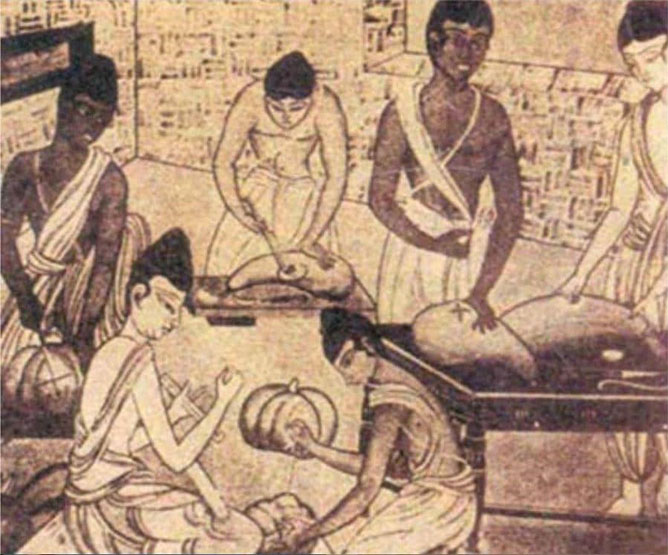
The image is from a 15th-century copy of the “Sushruta Samhita” kept at the Odisha State Museum, Bhubaneswar.
Quiz time
What were surgical instruments broadly classified into by Sushruta?
Answer – Yantra (blunt) and Shastra (sharp)
