
Sushruta Samhita – The Oldest Surgical Documentation
The original manuscript of Sushruta Samhita was lost over time, and the present text is a revised version by the Buddhist scholar Vasubandhu in circa AD 360-350. Following the Arabic trade route, in eighth century A.D, 'Sushruta Samhita' was translated into Arabic as Kitab-Shaw Shoon-a-Hindi and Kitab-i-Susrud, by the orders of Caliph Mansur in the 8th century. The Bower Manuscript is a Sanskrit-language manuscript written in the Brahmi Script on birch bark. Lieutenant H. Bower discovered the manuscript in 1890, from Kuchar, Eastern Turkestan and sent it to Colonel J. Waterhouse, the President of Asiatic Society of Bengal. Subsequently, Augustus Hoernle deciphered the manuscript. The first European translation of 'Sushruta Samhita' was published by Hessler in Latin and by Muller into German by Vellurs in the early 19th century and into English by Hoernle. The first complete English translation was done by Kaviraj Kunja Lal Bhishagratna in 1907 at Calcutta, in three volumes, and a later edition came out in 1963. It is argued whether Sushruta is a single person or if the Samhita is actually a compendium with multiple contributors, members of the gurukul of Sushruta. The followers of Sushruta were in fact called as 'Saushrutas'.
Sushruta defined surgical acumen as – “Surgery has the superior advantage of producing instantaneous effects by means of surgical instruments and appliances. Hence, it is the highest in value of all the medical tantras. It is eternal and a source of infinite piety, imports fame, and opens the gates of Heaven to its votaries. It prolongs the duration of human existence on earth and helps men in successfully fulfilling their missions and earning a decent competence in life.”
Sushruta defined surgical acumen as – “Surgery has the superior advantage of producing instantaneous effects by means of surgical instruments and appliances. Hence, it is the highest in value of all the medical tantras. It is eternal and a source of infinite piety, imports fame, and opens the gates of Heaven to its votaries. It prolongs the duration of human existence on earth and helps men in successfully fulfilling their missions and earning a decent competence in life.”
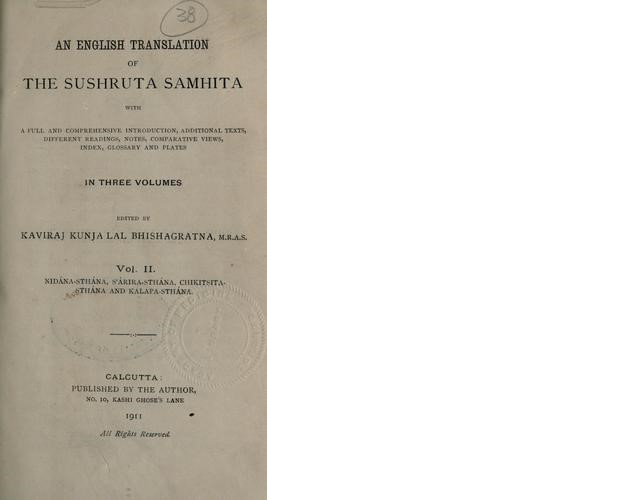
The first complete English translation – Kaviraj Kunja Lal Bhishagratna ,1907 Calcutta
Sushruta Samhita is a collection of surgical and allied knowledge, written in two parts, the Purva-tantra and Uttara-tantra. Purva-tantra has 120 chapters in five sections – Sutra-sthana, Sarira-sthana, Nidana-sthana, Chikitsa-sthana and Kalpa-sthana. The Chikitsa-sthana deals with surgical conditions including obstetrical emergencies, geriatrics and aphrodisiacs. The Kalpa sthana contains visha tantra which describes the nature of poisons and their management. Uttara-tantra covers Salakya, Kaya-chikitsa, Kaumarabhetya and Bhutavidya and Aupadravika, the description of many complications of surgical procedures like hiccough, fever, krmiroga, pandu, dysentery, cough, kamala, etc. The Salakyatantra has description of the various diseases of eye, ear, nose and head. The two parts together cover, apart from surgery, other specialities like medicine, paediatrics, geriatrics, diseases of the ear, nose, throat and eye, toxicology and psychiatry. The Sushruta Samhita describes over 300 surgical procedures and classifies human surgery under eight heads – Chedya (excision), Lekhya (scarification), Vedhya (puncturing), Esya (exploration), Ahrya (extraction), Vsraya (evacuation) and Sivya (Suturing). There are detailed descriptions on methods of haemostasis and leech therapy.
Like a true innovator. Sushruta designed his own instruments and did so by understanding his own needs as well as the utility of the beaks and claws and jaws of birds and animals, and naming his instruments after them. His Samdamsa yantras are the first forms of the modern surgeon's spring forceps and dissection and dressing forceps. In fact, his system of naming surgical tools after the animals or birds they resemble in shape, for example crocodile forceps, hawkbill forceps, is adopted even today. What is to be appreciated is not just the ingenuity of Sushruta but also the progress which research in metalurgy had made in India, way back in 600BC!
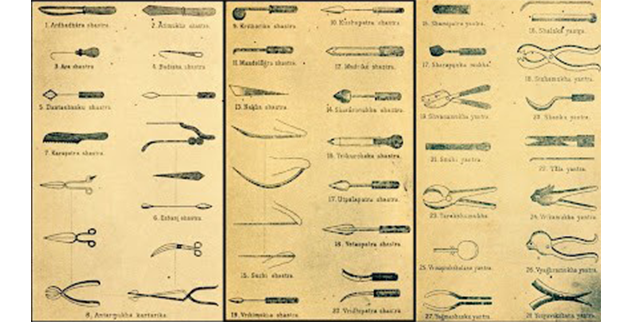
Instruments designed by Sushruta
The Sushruta Samhita thus is a comprehensive surgical textbook describing in detail general surgical techniques of making incisions, probing, extracting of foreign bodies, alkali and thermal cauterisation, tooth extraction, excision, the use of trocars to drain abscess, hydrocele and ascitic fluid, methods to stitch the intestines using ant-heads as stitching material, more complex procedures including removal of the prostate gland, urethral stricture dilatation, extraction of urinary bladder stone, hernia surgery, Caesarean section, management of hemorrhoids, fistulae, laparotomy and the management of intestinal obstruction, perforated intestine and accidental perforation of the abdomen with protrusion of omentum. Orthopaedic surgery, including management of dislocation of joints (sandhimukta) and fractures of the shaft (kanda-bhagna) bones and their reaction to the injuries, principles of fracture management, viz., traction, manipulation, appositions and stabilization including some measures of rehabilitation and fitting of prosthetics are all described. Ophthalmic surgery for various eye diseases, medical or surgical interventions including cataract surgery have also found a place in it. It also deals with dissection and the study of the anatomy of the human body, and even embryology and sequential development of the structures of the foetus!
Incision making, wound care and wound closure all find their due place in Sushruta Samhita. ‘Chedan Karma’ (Incision), according to Sushruta are mainly of three types – on head, eyelid, cheek, frontal region, lips, gums, axilla, hip joint – ‘Triyaka cheda’ means oblique incision, over upper and lower limb – ‘Chandramandal’ incision (Circular) and over anal region and penis incision should be ‘Ardhchandrakruti’ (Semicircular). He further went on to mention that if these rules of incision were not followed there were chances of injuring vital structures, delayed wound healing (Chirad Vranasanroho) and formation of keloid (Mamsakandi). Also while describing incision on breast abscess (StanaVidradhi) Sushruta has mentioned that incision should be taken such that it should avoid Papillary duct and areola otherwise there are chance of formation of sinus (Nandivrama).
While describing wound management (vrana-chikitsa) Sushruta has described sixty types of treatment (Shashthiupokrama). Interestingly, wound scrapping (lekhana) is mentioned as sixteenth upakrama. Thereafter before suturing wound should be thoroughly cleaned otherwise there will be chances of pus formation in wound. He mentioned that wounds with hard fatty mass should be scrapped. Scrapping should be such that edges of wound should be at equal level (Vartmanamtupramanenasamam). Thereafter before suturing wound should be thoroughly cleaned otherwise there will be chances of pus formation in wound. In Shashitiuparamas (Sixty methods) he described sixty types of treatments for different types of wounds and their treatments – Nirvapan, Vtkarika, Utsadan and Avasadan being a few treatments for large wound. The basic principles of wound care still remain the same even after so many years!
Sushruta has given detailed description of various techniques of wound closure. He mentioned four types of suturing – Vellitaka, Gofanika, Tunnasevani, Rujugranthi which should be used for different parts of body. He has also mentioned different types of needles to be used to different areas for wound closure. For areas which is less fatty in nature and over joints, round body two finger long needle (Vrultanguladwgyam) should be used while in areas with more fats – cutting body, three finger long triangular (Ayata tryangula tryastra) needle should be used and in areas where vital organs are nearby curved (Dhanurvakra) needle should be used.
His "paschat-karman" or post-operative schedule included the scar management protocols, rehabilitation and removal of complications. Fourteen types of bandaging capable of covering almost all the regions of the body and different methods of dressings with various medicaments are mentioned in Sushruta Samhita. Evidence points to a knowledge of Medhumeha (diabetes) and other co morbid conditions that can influence surgery!
Through all of Sushruta's flowery language, incantations and irrelevancies, there shines the unmistakable picture of a great surgeon. Undaunted by his failures, unimpressed by his successes, he sought the truth unceasingly and passed it on to those who followed. He attacked disease and deformity definitively, with reasoned and logical methods. When the path did not exist, he made one.’ – Dr Frank McDowell
Reference:
Bhattacharya S. Sushrutha – our proud heritage. Indian J Plast Surg. 2009
Jul;42(2):223-5. PMID: 20368862; PMCID: PMC2845369.
Quiz question
How was Venesection being taught at the time of Sushruta?
Answer
At the time of Sushruta (6th century BCE), venesection (Sira Vyadha), a critical method of bloodletting (Raktamokshana), was taught through a rigorous, practical, and simulation-based approach, emphasizing hands-on experience before practicing on patients. To teach the precise technique of venesection, students practiced on the stalks of water lilies (specifically Kamala and Kumuda). The soft, tubular structure of the lily stalks provided a realistic model for manipulating and puncturing veins without risk to a patient.
History of Surgery ASI team
Dr Kaushik Bhattacharya (Head of the team)
Dr Pratap Varute
Dr Patta Radhakrishna
Dr Surajit Bhattacharya
Dr Clement Rajan
Dr K Lakshman
Dr Mahesh Prabhu
