
History of Surgery Part 4 – Malignant Distemper” and the Establishment of the East India Company
“Malignant Distemper” and the Establishment of the East India Company
Farrukhsiyar ( 1683 –1719), was the tenth Mughal Emperor of India from 1713 to 1719.In 1717, Farrukhsiyar issued a farman (royal order) giving the British East India Company the right to reside and trade in the Mughal Empire. They were allowed to trade freely, except for a yearly payment of 3,000 rupees. This was because William Hamilton, a surgeon associated with the company cured Farrukhsiyar of a disease.

10th Mughal Emperor Farrukhsiyar ( 1683 –1719)
William Hamilton was a Scottish surgeon, associated with British East India Company (EIC), who travelled to India in the first half of the 18th century. He was a part of the delegation that went from Calcutta, the base of the company, to meet Mughal emperor Farrukhsiyar in his court in Delhi in 1715. The surgeon was called to treat a swelling in the groin of the Emperor Farrukhsiyar, which he treated successfully. In October 1715, the emperor again suffered from violent pain and feared it would be a fistula. Hamilton's treatment was again successful. As a result, in December 1715 Emperor Farrukhsiyar was finally able to perform the wedding of his beloved daughter with the daughter of the Rajah of Jodhpur, which had been delayed by his recurrent illness
The Surgeon Hamilton received the professional charges for his royal treatment to the Emperor on the eve of wedding as “an elephant, a horse, five thousand rupees in money, two diamond rings, a jewelled aigrette, a set of gold buttons, and models of all his instruments in gold."
But not deeming these sufficient, Farrukhsiyar asked Hamilton to name any reward “he wished for”. The good surgeon, however, proved to be an extremely unselfish man. He immediately asked the emperor to grant the British East India Company mission the objective with which they had arrived from distant Calcutta. The company's delegation was placed in high regard in the royal court of Farrukhsiyar. In April 1717, the emperor's farman (grant) was issued, meeting all the requests that the company had made in its petitions. Permission was granted to purchase 38 villages surrounding the three already held by the company (Sutanuti, Gobindapur and Kalikata, the predecessor of modern Calcutta). The company was also granted trading privileges in Bengal and further fortification of Calcutta.This grant was instrumental in the setting up of business and the colonisation of Bengal, later to be followed by the rest of India, by the East India Company.
After the grant, Farrukhsiyar expressed his wish to retain William Hamilton in Delhi as his personal surgeon, but Hamilton refused to stay. Hamilton promised to the emperor that after a visit to Europe he would return and join him as his personal surgeon.
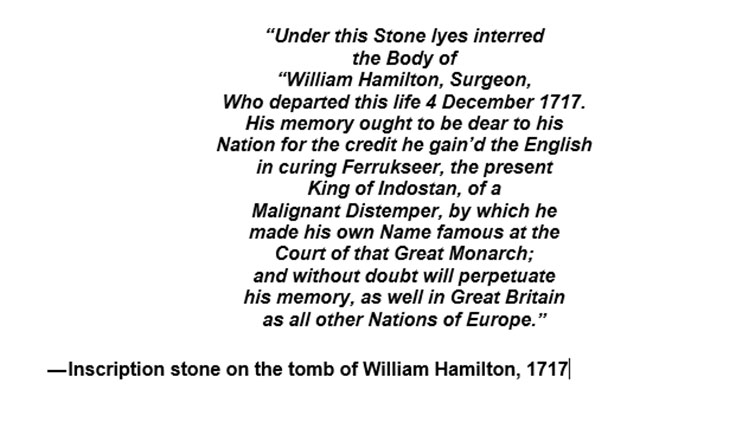
Hamilton died in Calcutta on 4th December 1717. He was buried at the churchyard of St. John's Church, Calcutta. The inscription tells the story of his curing a "Malignant Distemper" of Farrukhsiyar.
Quiz time
In 1645, Jahanara Begum, the favourite daughter of Mughal Emperor Shah Jahan, was severely burnt when her clothing caught fire in an accident during a dance performance.Local healers had failed to cure her, and, at the advice of vizier Assad Khan, the Emperor requested an English surgeon to treat Jahanara. Who was the surgeon?
Answer – Gabriel Boughton
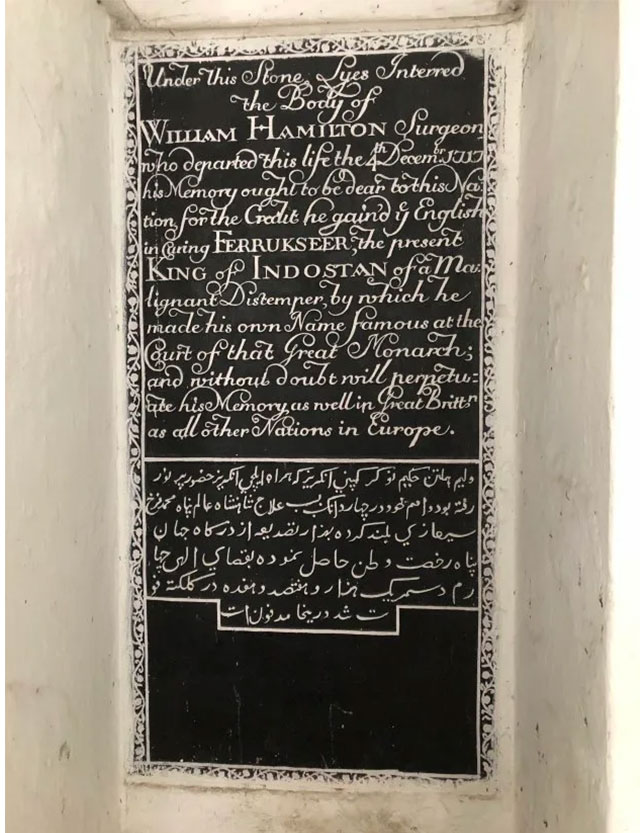
Inscription stone
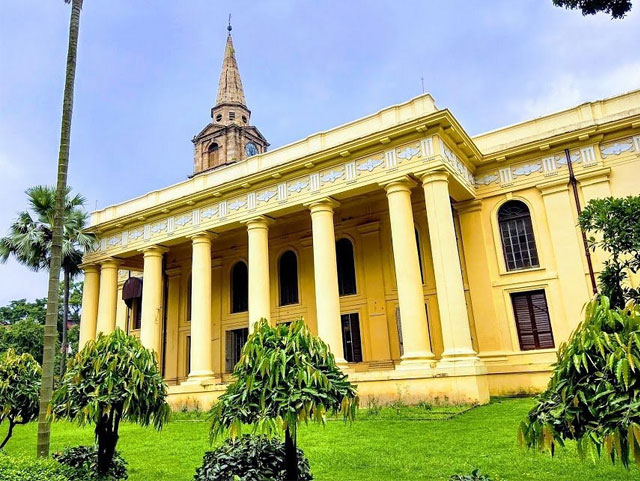
St John’s Church, Kolkata
