
History of Surgery Part 9 – The Indian Rhinoplasty -From Sushruta to Tribhovandas
Among the many contributions of Indian medicine to world surgery, none has attracted greater historical fascination than the technique of nasal reconstruction using a forehead flap. Known today to plastic surgeons as the paramedian forehead flap, this method of rhinoplasty is one of the oldest continuously practised reconstructive operations in human history. The story of its evolution spans more than two millennia, beginning with the surgical writings of Sushruta, passing through the craft traditions of early modern India, and eventually influencing European surgery through the famous report in the Gentleman’s Magazine in 1794. Yet the history of this procedure is richer and more complex than the often repeated narrative of “rediscovery.” Long before that celebrated publication, travellers in Mughal India had already witnessed the operation in practice.
The historical trajectory of Indian rhinoplasty is therefore not a tale of disappearance and rediscovery but rather one of continuity sometimes scholarly, sometimes artisanal, but rarely extinguished.
The Classical Origins: Sushruta and the Nasal Reconstruction
The earliest detailed description of rhinoplasty appears in the Sushruta Samhita, a surgical compendium generally dated between the first millennium BCE and the early centuries of the Common Era. Sushruta described a remarkably sophisticated method of reconstructing the amputated nose using a flap of skin raised from the cheek or forehead. The surgical steps are described with striking clarity: measurement of the nasal defect using a leaf template, elevation of a flap of appropriate dimensions, rotation and attachment to the nasal stump, and maintenance of the airway with tubular splints.
Sushruta’s account also emphasizes the importance of surgical instruments, wound care, and postoperative management. The text demonstrates a profound practical understanding of tissue viability and healing, even though it predates the knowledge of modern vascular anatomy his description remains one of the earliest examples of a pedicled flap in reconstructive surgery.
The cultural context of rhinoplasty in ancient India is equally important. Nasal amputation was a common judicial punishment for crimes such as adultery and theft. Consequently, the need for reconstructive surgery was not merely cosmetic but social and psychological. Restoring the nose restored honour and identity.
For several centuries after the composition of the Sushruta Samhita, Indian surgery flourished within the broader tradition of Ayurveda. However, by the early medieval period, the intellectual emphasis of medical scholarship had shifted increasingly toward pharmacology and internal medicine. Surgical practice gradually became marginalized within elite medical discourse.
The Migration of Surgical Knowledge
By the late medieval period, surgery in India appears to have moved largely out of the classical scholarly institutions and into hereditary craft communities. This phenomenon has been noted by several historians of medicine and was observed by European travellers as well. Certain surgical procedures—particularly those requiring manual dexterity rather than theoretical learning—were preserved through apprenticeship and family tradition.
Rhinoplasty became one of these craft procedures. The operation survived not in academic medical schools but among traditional practitioners who transmitted their knowledge from father to son. Although this shift represented a decline in formal surgical scholarship, it ensured the survival of specific operative techniques.
Thus, while classical Sanskrit texts faded from everyday medical practice, the practical surgical tradition itself persisted.
Niccolao Manucci and the Seventeenth-Century Observation
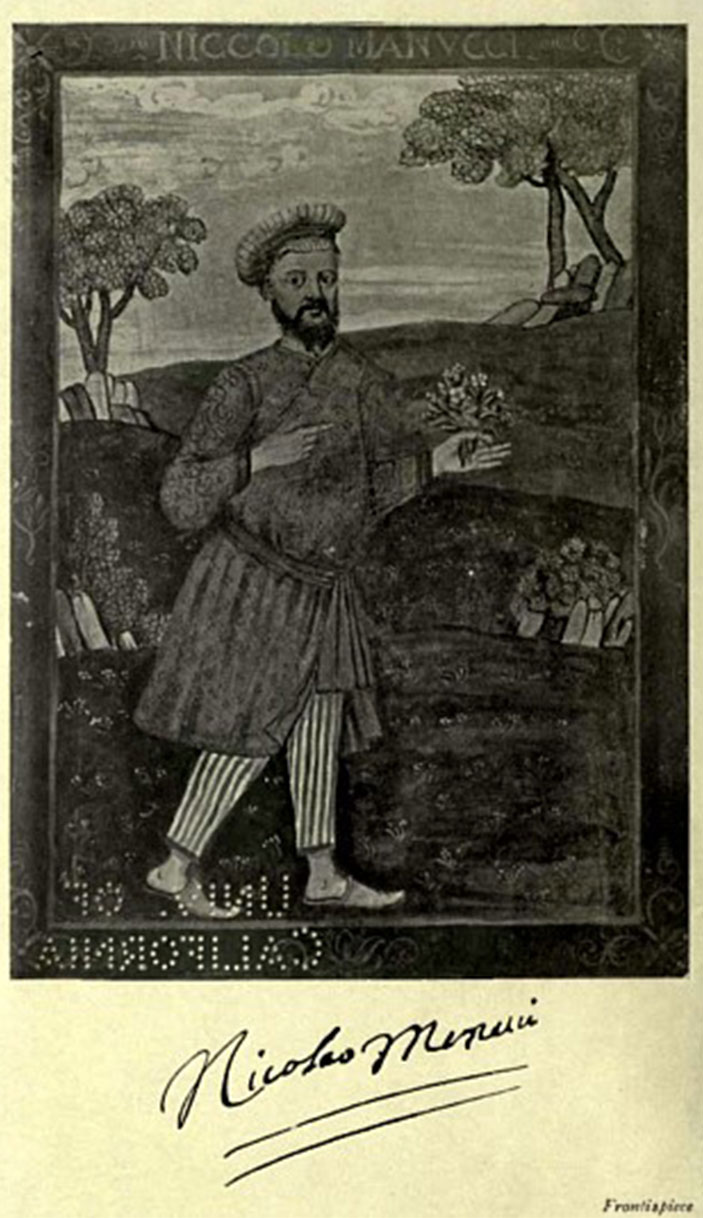
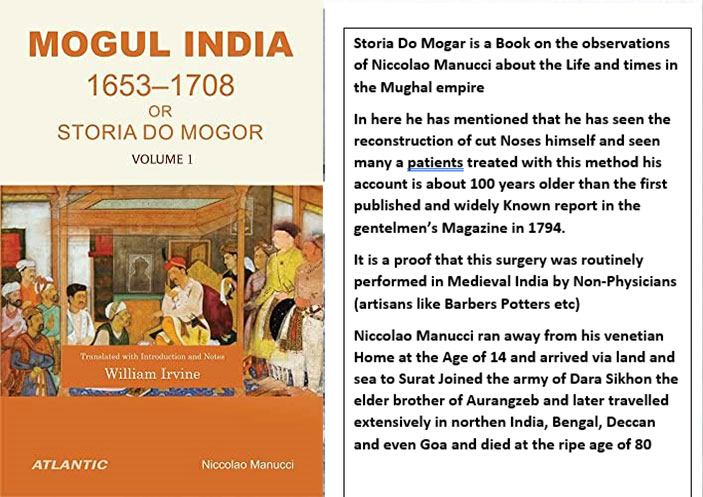
One of the earliest European eyewitness descriptions of Indian rhinoplasty comes from Niccolao Manucci (1638–1717), an Italian adventurer who spent much of his life in Mughal India. Manucci arrived in India as a young man in the service of Venetian traders and eventually became associated with the court of the Mughal emperor Aurangzeb. Over the course of several decades he travelled widely across northern India and compiled his experiences in a remarkable memoir known as Storia do Mogor.
Manucci’s narrative includes an account of nasal amputations carried out during military campaigns and the subsequent reconstruction performed by local surgeons. He described the method with surprising accuracy:
“The surgeons cut the skin of the forehead above the eyebrows and made it fall down over the wound on the nose… in a short time the wounds heal up… I saw many persons with such noses”.
This brief observation is historically significant for several reasons. First, it clearly identifies the forehead flap method, closely resembling the technique described by Sushruta many centuries earlier. Second, Manucci notes that he had seen many individuals who had undergone the procedure, implying that the operation was relatively common in the region. Finally, his account predates the famous Gentleman’s Magazine report by more than a century.
Manucci’s testimony demonstrates that rhinoplasty was not an isolated or rare procedure but part of a living surgical tradition in Mughal India. It also highlights the practical circumstances in which the operation was performed. Nasal amputation remained a form of punishment and humiliation in certain social contexts, creating a persistent demand for reconstruction.
European Travellers and the Craft of Indian Surgery
Manucci was not the only European observer to remark upon Indian surgical practices. Other travellers of the seventeenth century, including François Bernier and John Fryer, recorded aspects of indigenous medical practice during their time in India. Although their writings focused more on general medicine than surgery, they frequently commented on the empirical skill of Indian practitioners.
European observers were often puzzled by what they perceived as a contradiction: Indian surgeons demonstrated considerable technical ability despite lacking the anatomical training that had become central to European medicine after Vesalius. Operations such as rhinoplasty, lithotomy, and cataract couching were clearly being performed with competence, yet the practitioners belonged to artisan communities rather than scholarly institutions.
This situation illustrates a broader pattern in the history of surgery worldwide. Before the rise of modern academic medicine, surgical knowledge frequently survived in craft traditions—among barbers, bonesetters, and itinerant surgeons. India was no exception.
The Late Eighteenth Century: The Pune Rhinoplasty
The event that brought Indian rhinoplasty to the attention of European medicine occurred in western India toward the end of the eighteenth century. During the wars between the British and the Marathas, a Maratha cart driver named Cowasjee was captured and punished by nasal amputation. Several years later, a local practitioner reconstructed his nose using the traditional forehead flap technique.
Two British surgeons stationed in Pune, Thomas Cruso and James Findlay, witnessed the procedure and reported it in detail. Their description was published in 1794 in the Gentleman’s Magazine of London. The article included an illustration of the operation and described the technique step by step.
The publication created considerable excitement among European surgeons. Although reconstructive procedures had been attempted in Europe before, they were often unreliable and rarely successful. The Indian method, by contrast, appeared remarkably effective.
For European surgeons, this report represented a rediscovery of a lost art. For India, however, it was simply the continuation of a long-standing practice.
The Adoption of the Technique in Europe
The Gentleman’s Magazine report soon inspired several European surgeons to attempt the operation. Among them was Joseph Constantine Carpue, a London surgeon who undertook two rhinoplasty procedures using the Indian method in 1814.
Carpue carefully studied the original report and reconstructed the technique as faithfully as possible. His successful operations were published in 1816 in his monograph An Account of Two Successful Operations for Restoring a Lost Nose. The book included detailed illustrations and became widely known among European surgeons.
Carpue openly acknowledged the Indian origin of the procedure, referring to it as the “Indian method of rhinoplasty.” His work marked the beginning of modern plastic surgery in Europe and paved the way for further refinements by surgeons such as Dieffenbach in Germany.
Ironically, a surgical technique preserved for centuries in India through craft tradition now became celebrated within the emerging academic discipline of European surgery.
Rhinoplasty in Nineteenth-Century India
Despite the growing international recognition of the Indian method, the practice within India itself remained largely confined to traditional practitioners. Colonial medical institutions focused primarily on Western surgical techniques and often regarded indigenous practices with skepticism.
Nevertheless, the forehead flap rhinoplasty continued to be performed by hereditary surgeons in several regions of the subcontinent. One of the most notable practitioners of this tradition was Tribhovandas Motichand Shah of Junagadh in Gujarat.
Tribhovandas and the Living Tradition
Tribhovandas Motichand Shah (1849–1904) occupies an important place in the history of Indian rhinoplasty. Unlike many earlier practitioners whose work remained within local traditions, Tribhovandas documented his experience in writing. His observations were published in the Indian Medical Gazette in the late nineteenth century.
Tribhovandas described the rhinoplasty technique practiced in his community with remarkable clarity. The procedure closely resembled the classical method described by Sushruta and observed by Manucci centuries earlier. A flap was raised from the forehead, rotated downward to reconstruct the nasal defect, and supported with tubular splints to maintain the airway.
His report demonstrates that the technique had survived in essentially the same form for generations. It also illustrates the continuity between ancient surgical literature and the living traditions of Indian practitioners.
By the late nineteenth century, however, the balance of medical authority had shifted decisively toward Western institutional medicine. As hospitals and medical colleges expanded under colonial administration, indigenous surgical traditions gradually declined.
Yet the legacy of the Indian rhinoplasty remained embedded within global plastic surgery.
A Continuous Surgical Heritage
Viewed across the centuries, the history of Indian rhinoplasty reveals an extraordinary continuity of surgical knowledge.
- Sushruta provided the earliest detailed description of nasal reconstruction.
- Artisan surgeons preserved the technique during the medieval period.
- Niccolao Manucci recorded its practice in seventeenth-century Mughal India.
- The Pune rhinoplasty of 1794 introduced the method to Europe.
- Joseph Carpue established the operation within modern Western surgery.
- Tribhovandas demonstrated that the indigenous tradition continued well into the nineteenth century.
The story therefore challenges the simplistic notion that Indian surgery vanished after antiquity. Instead, it survived in unexpected places within craft communities, regional practices, and family lineages of surgeons who maintained their skills through generations.
For modern plastic surgeons, the forehead flap remains one of the most reliable techniques for nasal reconstruction. Its continued use in contemporary surgery stands as a testament to the ingenuity of the early Indian surgeons who first conceived it. More than two thousand years after Sushruta described the operation, the principles of the Indian rhinoplasty still guide reconstructive surgery around the world.
Summary:
By the seventeenth century, although classical surgical scholarship had declined, the practical art of rhinoplasty continued to survive in hereditary surgical communities. The Italian traveller Niccolao Manucci, who spent many years in Mughal India, recorded having seen numerous individuals whose noses had been reconstructed using a flap of skin taken from the forehead. More than a century later, British surgeons in Pune witnessed a similar operation performed on a Maratha cart driver named Cowasjee. Their report in the Gentleman’s Magazine in 1794 introduced the technique to European surgery, eventually inspiring Joseph Carpue’s celebrated operations in London. Yet the procedure never vanished from India itself. In the late nineteenth century, the surgeon Tribhovandas Motichand Shah documented the same method in the Indian Medical Gazette, demonstrating that the ancient surgical tradition described by Sushruta had survived in practice for nearly two thousand years.
References
Bhattacharya J. Indian medicine through travellers’ accounts with emphasis on anatomical knowledge: 17th–19th century. Indian Journal of History of Science. 2013.
Carpue JC. An Account of Two Successful Operations for Restoring a Lost Nose. London; 1816.
Findlay J, Cruso T. Account of a method of forming a new nose. Gentleman’s Magazine. 1794.
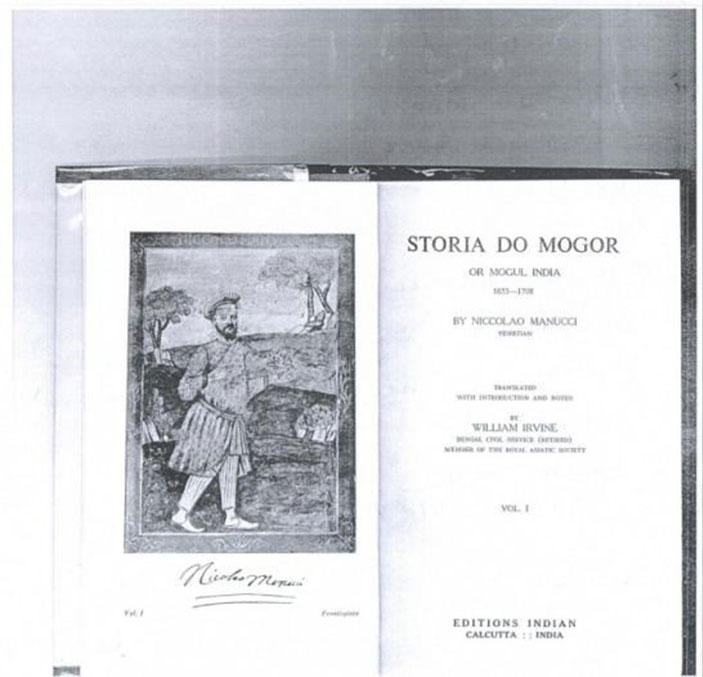
Manucci N. Storia do Mogor: Or Mogul India. Translated by William Irvine.
Mukhopadhyaya G. The Surgical Instruments of the Hindus. Calcutta; 1913.
Shah TM. Rhinoplasty in India. Indian Medical Gazette. 1889.
Sushruta. Sushruta Samhita. Various translations.
Quiz time
The punishment of nose amputation in ancient India contributed to the development of rhinoplasty. This punishment was commonly practiced for:
A. Theft
B. Adultery and crimes
C. Treason
D. Religious offenses
Answer: B. Adultery and crimes
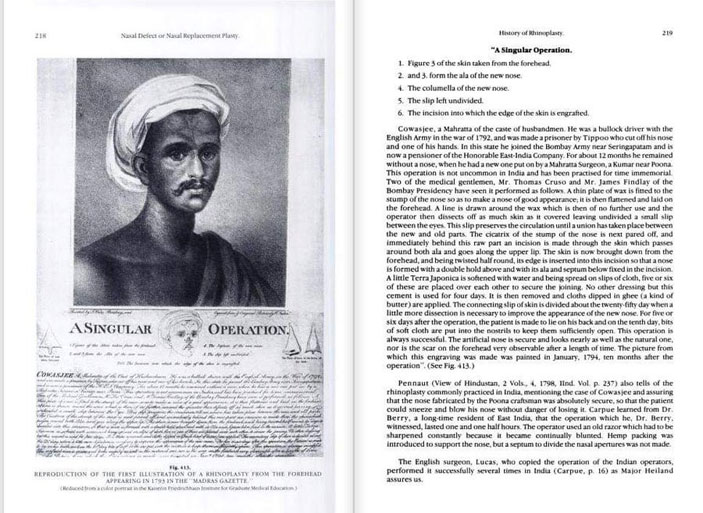
The widely Known report in the gentleman’s Magazine of the Indian Rhinoplasty 1n 1794 .Two British surgeons stationed in Pune, Thomas Cruso and James Findlay, witnessed the procedure and reported it 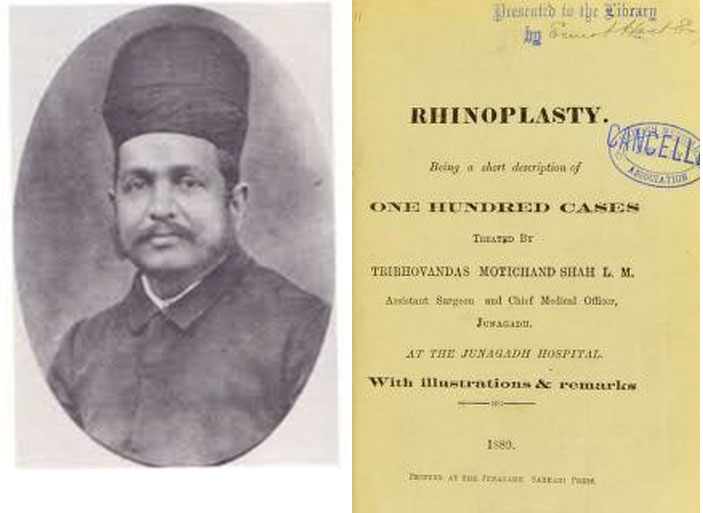
Dr Tribhovandas Motichand Shah The Chief Medical officer of Junagadh Princely State Trained in Modern medicine In Grant Medical college Mumbai was an expert in performing the Indian Rhinoplasty in the 19th Century and he published his cases in the Bombay gazette this is his report of having performed 100 cases . the story goes that a dacoid kadu Makrani was famous in cutting noses of his victims and Tribhuvandas reconstructed them (kadu Kate naak ………..)
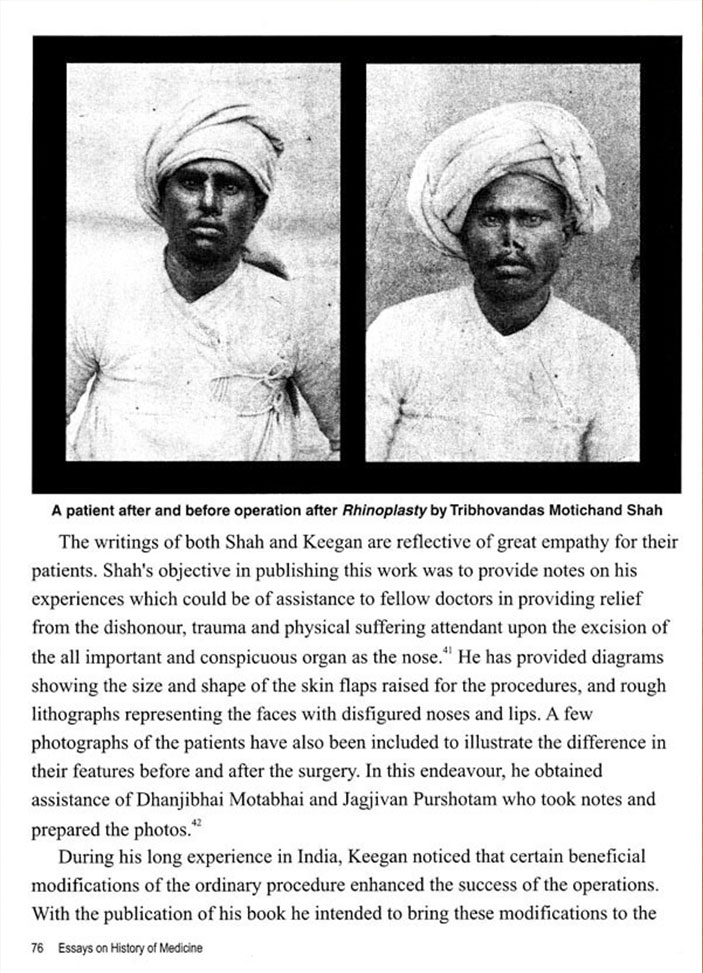
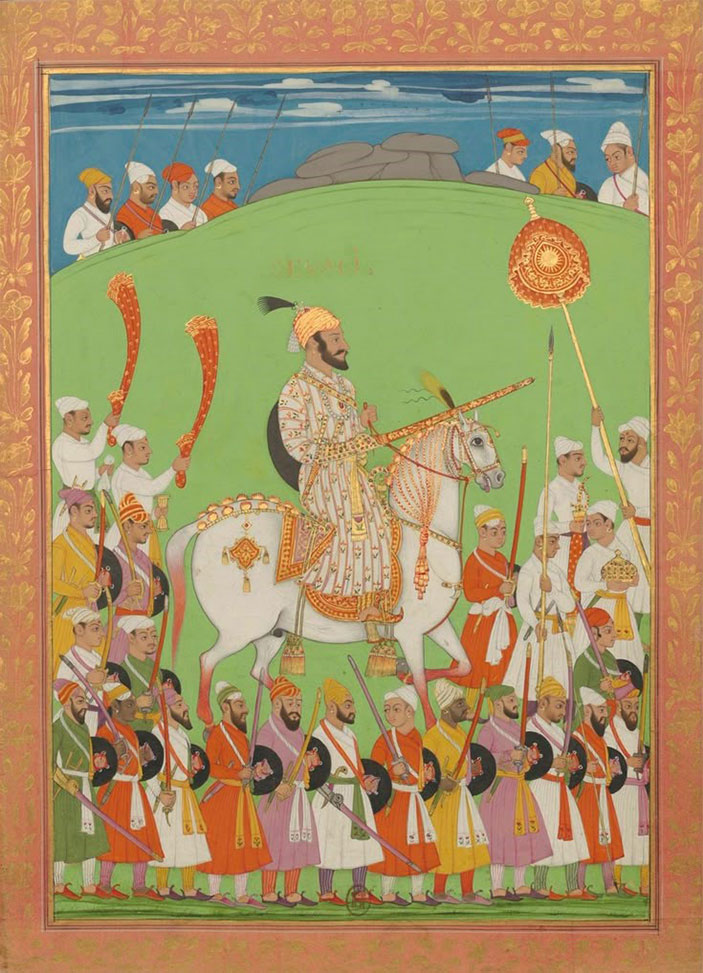
Painting of Sivaji Maharaj in the book Storia Do Mogar by Niccolo Manucci about Mughal India
History of Surgery ASI team
Dr Kaushik Bhattacharya (Head of the team)
Dr Pratap Varute
Dr Patta Radhakrishna
Dr Surajit Bhattacharya
Dr Clement Rajan
Dr K Lakshman
Dr Mahesh Prabhu
